

The term “coaching” originates from the word “coach,” which originally referred to a carriage. A carriage is a vehicle that transports people to a destination. In modern terms, it is similar to a taxi.
A taxi functions precisely because the destination is clear. If the request is simply “I want to go somewhere,” without any specific direction, the driver has no way of knowing where to go, and the passenger ends up just riding without purpose.
The same principle applies to coaching.
Table of Contents
A Basic Assumption When Taking a Taxi-The Clarity of a “Destination,” Shared with Coaching

There are many situations in which people choose to take a taxi, but they tend to share common conditions, such as:
- When you are worried about being late
- When you have a lot of luggage and want to prioritize efficiency
- When you determine that it is a more rational option than walking or using public transportation
Across all of these scenarios, one fundamental assumption remains the same: there is a destination. Without a destination, you would not even consider taking a taxi in the first place.
And once you get in, the first thing you do is communicate where you want to go. If you have a preferred route, you may share that as well.
It is precisely because of this information that the taxi can take you to your destination safely and efficiently.
In this respect, coaching is no different.
The Starting Point of Coaching: Articulating Vision and Purpose

In the early stages of coaching, the process begins with putting the client’s long-term vision into words. This involves exploring questions such as “When you think about the future, what kind of outcome would feel most meaningful to you?” and “What does your desired state look like in concrete terms?” and expressing one’s values and ideals in a clear, verbal form.
From there, the focus shifts to examining the underlying purpose behind that vision. In other words, “What is driving your desire to achieve this?” The coach and client work together to uncover the motivation and background driving the vision.
However, vision and purpose often remain abstract. That is why the next critical step is to answer the question, “What specific outcomes or changes would indicate success for you?” This is where the concept of a goal comes into play.
SMART Goal Setting: Establishing Specific and Realistic Goals
This is not unique to coaching, but goal setting is most effective when it is based on the SMART framework rather than vague aspiration.
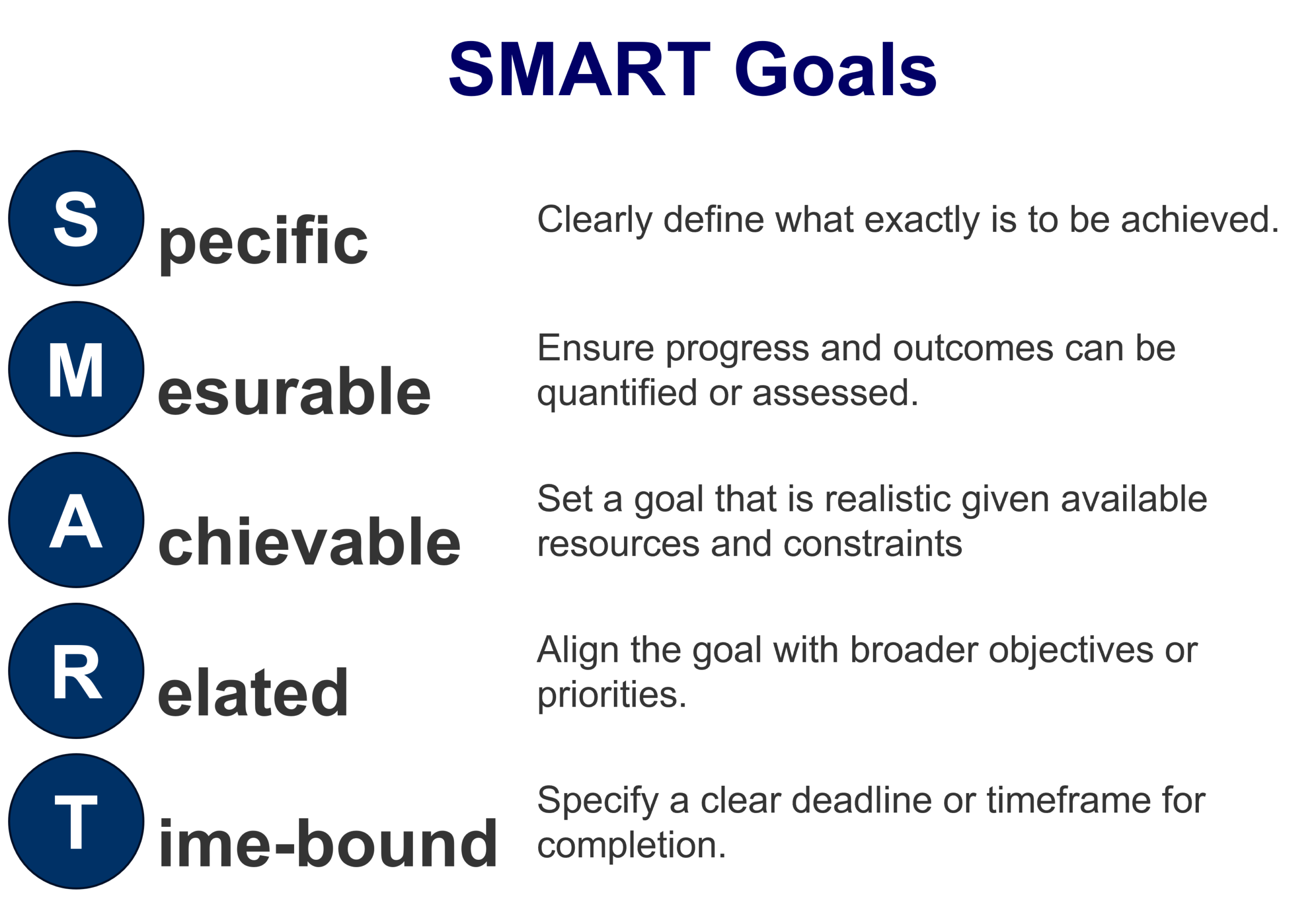
Breaking Down Goals to Clarify the Path Forward
When a goal is set based on the SMART framework and then further broken down, “process goals” (intermediate outcomes) begin to emerge. These process goals, like the higher-level goal, should also be defined using the SMART principles.
Let us look at a case example of an expatriate employee, Mr. T
- Name (pseudonym): Mr. T
- Age and Position: Late 30s, Sales Manager at a Japanese manufacturing company
- Background: Scheduled to begin a three-year overseas assignment in the United States next month. Has concerns about English proficiency, cultural differences, and management.
- Aspiration: Wants to build trust with local staff and become a leader who delivers results using his own words
Vision and Purpose (Mr. T’s Case)
- Vision: To become a sales leader who can engage in discussions and negotiations on equal footing in English with local staff and clients, and deliver results during the overseas assignment
- Purpose: To build a track record as a global professional and become someone who can be entrusted with international projects even after returning to Japan
Multiple Goals (Articulating the Vision Based on the SMART Framework)
| Area | SMART Goal |
|---|---|
| Language Skills | Achieve a TOEIC score of 850 within 6 months (current 700) |
| Relationship Building | Conduct 1:1 meetings with 5 key local team members within 3 months of assignment and obtain feedback on relationship |
| Presentation | Deliver 3 sales presentations in English within 6 months of assignment and secure at least 1 business opportunity |
| Cross-Cultural Adaption | Read 2 books on U.S. business culture before departure and prepare 10 questions for local staff |
Process Goals Focused on Language Proficiency
Among the language related goals, we will focus on the TOEIC score, which allows for clear tracking of progress, and further break it down.
Goal: Achieve a TOEIC score of 850 within six months (current score: 700)
Process Goal 1: Achieve 450 in the Reading Section
- 1-1: Complete one full cycle of a business English vocabulary book within two months and achieve at least 80 percent accuracy on vocabulary questions in practice tests
- 1-2: Within three months, develop the speed and accuracy to answer
- 1-3: Within five months, consistently achieve a reading score of 450 or higher on official practice tests
Process Goal 2: Achieve 400 in the Listening Section
- 2-2: Within three months, listen to a business English podcast for 30 minutes daily and aim for at least 90 percent comprehension
By working backward from the final goal and breaking it down in this way, concrete actions gradually become clear.
Session Goals: The “Small Destination” for Each Conversation

In coaching sessions, each meeting is guided by a “session goal,” a small, specific destination based on the broader process goals.
For example:
- “I want to identify why my reading speed slows down with longer passages.”
- “I want to clarify why I have not been consistent with podcast practice and how to address it.”
- “I want to evaluate my presentation practice and identify areas for improvement.”
By accumulating these session level goals, progress steadily builds toward achieving the larger objective.
Coaching Without Clarity on “What You Want”
At times, people seek coaching while feeling uncertain, thinking, “I do not know what I should do in the future.” A professional coach will meet the client where they are and help uncover their thoughts and values through thoughtful questioning.
However, when there is no sense of direction at all, the conversation can occasionally lose momentum.
Regardless of the starting point, clients may feel that the session was valuable in the moment. However, without a sense of what lies ahead, it can resemble getting into a taxi without a destination and simply making small talk with the driver.
Coaching is a time-based dialogue. Just like a taxi meter continues to run regardless of distance traveled, time continues to pass. With that in mind, having at least a general sense of direction or vision before entering a session leads to a more meaningful and productive experience.
Choosing the Right Support and the Importance of Intention
Consulting, counseling, and coaching are all forms of professional support, but what truly matters is whether there is a clear intention behind seeking that support.
- A desire to break through the current situation
- A need for clear advice
- A wish to stabilize one’s mental state
- A goal to overcome past trauma
Regardless of the approach, any form of support becomes meaningful when there is an underlying intention such as “I want to achieve this” or “I want to change my current situation.”
It is precisely this intention that allows coaching to deliver its full value.
Coaching Begins with “Where You Want to Go”
Coaching does not move forward simply by participating in it.
It is the presence of a destination that allows you to move forward together with a coach as your partner along the journey.
That journey is guided by five key “maps”:
- Vision ― What kind of future do you want to create?
- Purpose ― Why do you want to pursue that future?
- Goal ― What needs to be achieved to say the vision and purpose have been realized?
- Process Goals ―The intermediate outcomes that lead to the goal
- Session Goals ― The specific focus for each individual conversation
With these maps in hand, why not take the first step toward the future you have envisioned for yourself?
Related Services
Cornerstone Strategy LLC offers coaching for organizations and global career coaching for individuals who want to clarify leadership challenges, career questions, organizational issues, or next steps.

Disclaimer
This article has been prepared by Cornerstone Strategy LLC for informational purposes only. It is based on generally available information, including publicly available guidelines, regulations, and case law related to U.S. human resources, employment, tax practices, organizational and talent development, leadership development, career development, and coaching. It is provided from the perspective of an HR consultant and coach.
Cornerstone Strategy LLC is not a law firm, accounting firm, licensed tax advisory firm, medical provider, psychotherapy provider, counseling provider, or any other licensed professional practice providing legal, tax, medical, psychological, or therapeutic services.
The content of this article does not constitute legal, accounting, tax, medical, psychological, therapeutic, investment, or other professional advice, and should not be relied upon as such. It does not guarantee legal validity, tax treatment, organizational outcomes, HR outcomes, behavioral change, career outcomes, coaching outcomes, or applicability to any specific situation.
Before making decisions related to employment, tax, contracts, compensation, termination, disciplinary action, HR policies, required forms, or any matter involving physical or mental health, you should consult with qualified professionals such as licensed attorneys, certified public accountants (CPAs), tax advisors, medical professionals, psychologists, or other appropriately licensed professionals who are knowledgeable about applicable federal and state laws and professional standards.
Cornerstone Strategy LLC assumes no responsibility or liability for any loss or damages arising from the use of, reliance on, or actions taken based on this article.