

In recent years, one of the HR topics that has rapidly gained attention among Japanese companies is job-based HR. Under the traditional membership-based employment model, challenges such as unclear job definitions and the difficulty of seeing employees’ areas of expertise have made it increasingly difficult to respond to globalization and make effective use of highly skilled talent.
Against that backdrop, it was only natural that interest would grow in a job-based approach that clarifies jobs and defines roles and responsibilities.
However, if we look at more recent discussions, particularly in the United States, we can already see movement beyond the job-based approach. What is emerging is a way of thinking that redesigns the relationship between talent and jobs around skills.
According to Deloitte’s research1, current work realities reveal the following.
63 percent of executives say that work is being performed outside the scope of core job descriptions, and 81 percent say that work is carried out across functions.
This means that the reality of work has already moved beyond the framework of the job description.
At the same time, it would not be accurate to treat this as an excessively new concept. Discussions around skill-based approaches have been underway in the United States for several years, and the idea has begun to spread within the HR field in Japan as well.
That said, there is still a significant gap between conceptual understanding and actual implementation. Deloitte reports that while more companies are moving in a skill-based direction, fewer than 20 percent, or less than one in five companies, have been able to introduce clear and repeatable organization-wide mechanisms.2
In this article, we will first examine the changes taking place in hiring, then organize the essence of skill-based talent strategy, the reasons why implementation is difficult, and the implications for Japanese companies through specific case studies from overseas companies.
Skill-Based Approaches Are First Advancing in Hiring
The shift toward skill-based approaches is beginning not with internal systems, but with hiring.
According to a survey by the National Association of Colleges and Employers, approximately two-thirds of U.S. companies say they are using skill-based hiring methods in entry-level recruiting. 3
This indicates that skill-based hiring is not just an initiative pursued by a handful of advanced companies, but something that is becoming widely adopted.
Here, “Skill-Based Hiring” refers to the idea of evaluating candidates based not on superficial indicators such as educational background or past career history, but on actual capabilities and potential.
However, there is an important caveat to this trend. A joint study by Harvard Business School and the Burning Glass Institute found the following4:
- Many companies say they are adopting skill-based hiring, but in reality, their hiring practices have not changed.
- By contrast, among companies that actually changed their hiring requirements and related mechanisms, the share of hires without a college degree increased by an average of 18 percent.
- The retention rate of hires without a college degree was 10 percentage points higher than that of college graduates.
In other words, while skill-based hiring can be expected to deliver a certain level of benefit once implemented, the findings also show that there are substantial barriers to putting it into practice.
This same structure can be applied directly to skill-based talent strategy as a whole.
What is Skill-Based Talent Strategy?

Skill-based talent strategy is an approach that views talent as a collection of skills, redefines work as a combination of required skills, and dynamically connects the two.
In the conventional job-based model, a job is defined first, and then a person is assigned to that job. The skills required to perform the work are included within the job, but the unit of management is, first and foremost, the job itself.
By contrast, in a skill-based approach, people are understood in terms of skills, and jobs are also broken down into collections of skills. On that basis, talent and jobs are matched.
Deloitte describes this as a shift from job-centered management to a dynamic operating model centered on skills.1
Korn Ferry likewise argues that a skill-based organization is not simply about managing skills, but about redesigning roles, careers, and organizational structures as well. The firm also reports that required skills have changed by 25 percent since 2015 and that this pace of change is likely to accelerate further in the future.5
In an environment like this, human capital management can no longer keep up if it relies only on fixed job definitions.
The Essence of a Skill-based Approach Is Redesigning the Relationship Between Talent and Jobs
The essence of a skill-based approach is not the detailed management of skills. Its essence lies in shifting the relationship between talent and jobs from something static to something dynamic.
Traditionally, the assumption was that one employee belonged to one job and fulfilled a role within it. Under a skill-based approach, however, that assumption breaks down. A single job is not always performed by one person alone. Increasingly, work is carried out by combining the skills of multiple people. At the same time, it also becomes normal for one employee to be involved in multiple pieces of work.
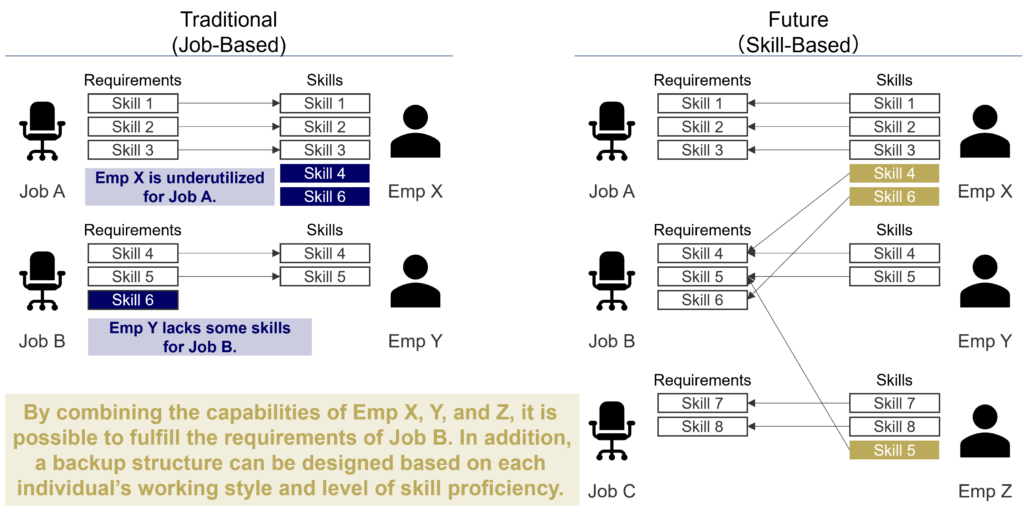
As a result, cross-organizational ways of working become more common, and conventional systems for evaluation and labor management can no longer fully cope. As Deloitte’s research shows, much of today’s work is already taking place outside the scope of job descriptions or across functions.
A skill-based approach is a way of aligning systems with that reality.
Why Is It Still Not Being Adopted Even Through It Is Understood?
A skill-based approach is one that many companies find intuitively persuasive. And yet, actual implementation has not progressed very far. The reason is that adopting it requires a fundamental shift in the assumptions behind existing systems.
First, there is challenge of defining and visualizing skills in the first place. Skills are abstract, and the way they are defined in practice changes significantly depending on the level of granularity.
Next, there is the difficulty of linking skills to performance evaluation systems. When one employee takes on multiple roles, the design of both evaluators and evaluation criteria becomes more complex.
In addition, compensation systems and labor management must also be reconsidered. As more employees work across organizational boundaries, ideas about accountability and workload management also have to change.
Boston Consulting Group points out that skill-based organizations often fail because implementation is not tied to business issues, or because the design starts with technology rather than the business need. 6
In other words, a skill-based approach is not a system implementation issue. It is something that should be designed starting from management challenges.
Case Studies – How Is Skill-Based Talent Strategy Being Implemented?
Here, we will organize how skill-based talent strategy is being used in practice through specific corporate examples.
Unilever | Increasing Talent Mobility Through an Internal Talent Marketplace7

Unilever is one of the most representative companies to move beyond treating skill-based talent strategy as a concept and to put it into practice in the form of talent mobility.
What the company aimed to create was an environment in which employees would not remain confined to fixed jobs or organizations but could access opportunities within the company based on their own skills and aspirations. Behind this was the recognition that, in a fast-changing business environment, traditional static talent allocation was no longer sufficient to make effective use of the skills the company needed.
To address this challenge, Unilever introduced an internal talent marketplace called Flex Experiences and built a mechanism for matching employees and jobs on a skills basis. Employees can apply for short-term projects or new roles based on their skills and interests, while the organization identifies the skills it needs and invites talent accordingly.
One defining feature of this initiative is that it significantly changes the way talent allocation decisions are made. Instead of managers or HR determining transfers in the traditional way, employees themselves proactively choose opportunities, and matching is conducted on the basis of skills.
This mechanism goes beyond simply improving the efficiency of talent allocation. It changes the very way careers are understood within the company. Rather than remaining fixed in one job for the long term, employees build their careers by expanding their skills through multiple projects and roles. This represents a shift away from careers centered only on upward promotion and advancement, toward careers that also include lateral and diagonal movement.
Equally important is the fact that this mechanism creates significant value for the company itself. By making visible the skills that already exist inside the company and reallocating them, Unilever is able to secure needed capabilities without relying solely on external hiring. It also contributes to stronger employee engagement and greater willingness to learn.
What this case shows is that the essence of skill-based talent strategy lies not in “understanding skills,” but in “dynamically reconstructing the relationship between talent and jobs based on skills.” Unilever can be said to be operating this effectively by embedding the mechanism not merely as a formal system, but into the company’s everyday way of working.
Cargill | A Practical Transformation Approach That Starts With Skill Visibility8

Cargill provides a highly instructive example of how skill-based talent strategy should be advanced in stages.
The challenge the company faced is one shared by many global corporations. It was unable to accurately understand what skills actually existed inside the organization. While the company could identify people in terms of jobs and titles, it could not clearly see what capabilities those individuals truly had or how those capabilities could be applied to different kinds of work.
To address this issue, Cargill first focused on making skills visible. Specifically, it defined skills, organized them into a shared language, and built the foundations for storing them as data. What is important is that this initiative was not designed from the beginning as a company-wide system. Cargill started small in specific areas and gradually expanded the scope of how skill data was used.
This approach shows a practical path for implementing skill-based talent strategy. In other words, rather than trying to change the entire HR system from the outset, the company first sought to understand the current state through visualization and then broadened the areas of application from there.
This effort was not simply about organizing data. By defining skills as a shared language, Cargill created a foundation for understanding talent across organizational boundaries. That made it possible to utilize talent from a broader perspective rather than keeping people confined within departmental silos.
Cargill’s case shows that skill-based talent strategy is not something that is completed all at once, but something built progressively over time. And its first step lies not in institutional reform, but in understanding and visualizing skills.
Walmart | Enhancing Talent Utilization Through the Redesign of the Internal Labor Market9,10

Walmart’s approach is notable in that it implements skills-based talent strategy not as “an alternative to acquiring talent externally,” but as “a way of reactivating internal talent.”
The company faced a clear business challenge in the form of a shortage of logistics drivers. In the United States, the shortage of truck drivers has become severe, making it difficult to secure a stable supply of talent solely through the external labor market. To address this challenge, Walmart chose not to depend on the external labor market, but instead to solve the issue through internal workforce development.
The specific initiative was the Associate to Driver Program. Through this program, employees working in stores and warehouses can receive company support to obtain the qualifications required to become truck drivers and transition into role as dedicated Walmart drivers. A particularly noteworthy aspect of this program is that the company covers the full cost of obtaining the qualification. Traditionally, earning a commercial driver’s license often requires several thousand dollars in expenses, but under this system, employees can move into a new occupation without financial burden. In addition, as of 2022, Walmart significantly improved compensation for drivers, raising pay to as much as 110,000 dollars.
The essence of this initiative is not simply workforce development. Viewed through the lens of skill-based talent strategy, three structural changes are taking place.
First, the company no longer sees people as fixed within a particular occupation, but as individuals who can be redeployed based on skills. Employees are not locked into the role of store associate. By acquiring new skills, they can move into entirely different occupations.
Second, Walmart is shifting toward a talent strategy that does not depend on external hiring. Rather than acquiring needed skills from outside, it develops them internally and uses redeployment to address talent shortages.
Third, the very idea of career is changing. Instead of assuming promotion and advancement within the same occupational track, the company is creating a model in which careers can involve changing occupations themselves on the basis of skills.
This case shows that skill-based talent strategy is not simply an HR initiative, but a tool for solving business problems. Walmart used a skill-based way of thinking to build a practical solution to the very concrete challenge of driver shortages.
At the same time, this initiative also creates significant value for employees. By enabling the acquisition of new skills and possibility of a substantial increase in earnings, it is expected to strengthen employee engagement and retention.
Walmart’ example offers an important insight into implementing skill-based talent strategy. It shows that a skill-based approach functions only when it is tied to a concrete business challenge rather than remaining an abstract institutional design concept. It also demonstrates that the starting point does not necessarily have to be a company-wide transformation, but can begin in a specific role or function and still be fully viable.
IBM | Building the Foundation for Treating Skills as Data11

IBM’s approach is notable because it established the prerequisites necessary to make skill-based talent strategy workable. In other words, it transformed skills from an abstract concept into data that the organization can actually use.
The company introduced a digital badge system that certifies the acquisition of specific skills and knowledge through training, hands-on work experience, and evaluation processes. The importance of this system lies not in the mere awarding of credentials. Its significance is that it clearly defines which skills a person possesses and at what level, sand makes that information shareable across the organization. As a result, employees’ capabilities are separated from vague impressions and can instead be understood as concrete data.
Digital badges also contribute to more advanced talent management. Experiential Communications notes that making skills visible helps increase motivation to learn and clarifies career development. 12Employees become able to objectively understand their own skills and take more initiative in choosing which capabilities to develop next.
Viewed through the lens of skill-based talent strategy, IBM’s approach brings about three changes.
First, it defines and standardizes skills. By treating skills as a shared language, it becomes possible to understand talent across organizational boundaries.
Second, it converts skills into data. Once skills can be grasped quantitatively, the accuracy of placement and development decisions improves.
Third, it connects skills and careers. When it becomes clear which skills lead to value in which domains, career development becomes more self-directed.
What IBM’s case shows is that skill-based talent strategy should not begin with institutional design, but with the foundation for defining, measuring, and sharing skills. Without that foundation, matching talent and jobs simply cannot work.
IBM can therefore be positioned as a company that has built the underlying foundation for skill-based talent strategy.
The Common Structure That Emerges from These Cases
At first glance, the approaches taken by these companies may seem quite different. Unilever focuses on internal mobility, Cargill on visualization, Walmart on development and redeployment, and IBM on infrastructure. Their starting points and methods are clearly not the same.
However, when these cases are organized structurally, a clear shared direction of change begins to emerge.
First, none of these companies is denying the concept of the job itself. Jobs and roles still exist. What matters, however, is that they are no longer treating the job as the only unit of management. To complement the reality of work, which can no longer be fully captured by jobs alone, they are introducing skills as an additional organizing axis.
Second, all of these companies are aiming for the “redeployment of talent” based on skills. At Unilever, this appears in participation in internal projects. At Walmart, it appears in occupational transitions. At Cargill, it appears a cross-organizational understanding of talent. At IBM, it appears in building the preconditions for placement based on skill data. What all of them share is the idea that people should not be fixed in place but moved according to the skills required.
Third, none of them stops at making skills visible. Cargill and IBM begin with visualization, but that is only the starting point. Unilever connects it to matching, and Walmart connects it to career transitions. The common structure is that skills do not create value merely by being visible. They acquire meaning only when connected to jobs.
Fourth, implementation is gradual. None of these companies introduced the approach as a company-wide system from the very beginning. They started with specific issues, specific domains, or specific functions, and then expanded from there. As Boston Consulting Group has pointed out, skill-based approaches should be designed starting from concrete use cases, and the practice of these companies aligns with that view.
Most importantly, the end state all of them are aiming for is “talent mobility.” This does not simply mean increasing the frequency of transfers. It means creating a state in which people are not fixed within a specific job or organization but can contribute to multiple tasks and roles according to their skills.
Once this structural shift is understood, the essence of skill-based talent strategy becomes clear.
It is not about managing skills.
It is about redesigning the relationship between talent and jobs.
Where talent used to be assigned starting from the job, in a skill-based model, jobs and talent are reconnected starting from skills.
For that reason, a skill-based approach is less a new HR system and more a new way of thinking about how an organization should operate. These corporate examples show that this shift has already begun, and that it is not something that can be realized all at once, but something built step by step over time.
Implications for Japanese Companies
The realistic approach that Japanese companies should take is clear.
First, they should begin by experimenting in specific domains such as hiring and building small successes. Then, they should expand gradually into broader functions, areas, and departments. Most importantly, they should begin with use cases tied to actual business issues.
In Closing
Skill-based talent strategy is not simply a new system. It is a way of rethinking the very assumptions behind how we understand the relationship between talent and jobs. It is already spreading in hiring, but implementation as a formal system is still at an early stage.
That is precisely why, for Japanese companies, what matters is not simply understanding the concept, but thinking about it in light of their own challenges.
A skill-based approach is the starting point for thinking about the next generation of talent strategy.
Related Services
For companies exploring how to incorporate skill-based talent strategy into HR strategy and talent management, Cornerstone Strategy LLC supports the development of HR strategies aligned with business goals and organizational priorities.
References
- Deloitte | Building tomorrow’s skills-based organization ― Jobs aren’t working anymore ↩︎
- Deloitte | he skills-based organization: A new operating model for work and the workforce ↩︎
- NACE | Job Outlook 2025 ↩︎
- Harvard Business School & The Burning Glass Institute | Skills-Based Hiring: The Long Road from Pronouncements to Practice ↩︎
- Korn Ferry – Redefining a Skills-Based Organization ↩︎
- Boston Consulting Group | Skill-Based Organizations Aren’t Reaching Their Potential. Here’s How They Can Succeed ↩︎
- my HR future | How Unilever has Created a Culture of Internal Talent Mobility ↩︎
- OpusWorks | Continuous Improvement for Everyone at Cargill ↩︎
- Walmart | Drive-In Opportunity: Walmart Raises Driver Pay and Launches Private Fleet Development Program ↩︎
- Walmart | With Walmart’s New Associate-to-Driver Program, the Wheel Is Within Reach ↩︎
- Credly | Case Study – Shifting The Up-Skiling Paradigm: Digital badges help IBM create a diverse, inclusive workforce ↩︎
- Experiential Communications | Episode #11: David Leaser of IBM on how Digital Badges Can Bring Multiple Benefits to an Organization ↩︎

Disclaimer
This article has been prepared by Cornerstone Strategy LLC for informational purposes only. It is based on generally available information, including publicly available guidelines, regulations, and case law related to U.S. human resources, employment, tax practices, organizational and talent development, leadership development, career development, and coaching. It is provided from the perspective of an HR consultant and coach.
Cornerstone Strategy LLC is not a law firm, accounting firm, licensed tax advisory firm, medical provider, psychotherapy provider, counseling provider, or any other licensed professional practice providing legal, tax, medical, psychological, or therapeutic services.
The content of this article does not constitute legal, accounting, tax, medical, psychological, therapeutic, investment, or other professional advice, and should not be relied upon as such. It does not guarantee legal validity, tax treatment, organizational outcomes, HR outcomes, behavioral change, career outcomes, coaching outcomes, or applicability to any specific situation.
Before making decisions related to employment, tax, contracts, compensation, termination, disciplinary action, HR policies, required forms, or any matter involving physical or mental health, you should consult with qualified professionals such as licensed attorneys, certified public accountants (CPAs), tax advisors, medical professionals, psychologists, or other appropriately licensed professionals who are knowledgeable about applicable federal and state laws and professional standards.
Cornerstone Strategy LLC assumes no responsibility or liability for any loss or damages arising from the use of, reliance on, or actions taken based on this article.