

Last Update:September 11, 2025
The minimum wage in the United States cannot be understood simply as “the federal minimum wage of $7.25 per hour.”
Employers must understand the three-layered legal structure of federal, state, and local minimum wage laws, as well as special rules for tipped employees, young workers, workers with disabilities, and student workers. They also need to understand how minimum wage requirements relate to the Regular Rate of Pay (RROP). Without this broader understanding, companies may unknowingly expose themselves to compliance violations.
Minimum wage violations can lead to back payment of unpaid wages, penalties, and class-action litigation. For Japanese companies operating in the United States, this is not merely a local U.S. subsidiary issue. It can also have significant implications for global HR governance at the Japanese headquarters.
This article provides a comprehensive overview of the key concepts and practical knowledge needed for executive decision-making, HR policy design, and day-to-day workforce management.
Table of Contents
Federal Minimum Wage
The federal minimum wage has remained unchanged since 2009. As the cost of living has continued to rise, many states and cities have established their own minimum wage rates. In most cases, the minimum wage set by states or cities is higher than the federal minimum wage.
- Coverage: Nonexempt employees covered by the FLSA
- Rate: $7.25 per hour, unchanged since 2009
- Legal basis: Fair Labor Standards Act (FLSA), 29 U.S.C. §2061
Minimum Wage by State and Major City
In the United States, federal, state, and local minimum wage laws coexist. When multiple minimum wage laws apply, employers must always apply the higher applicable rate.
U.S. employers are legally required to pay minimum wage and overtime pay, meaning premium pay for hours worked over 40 in a workweek. This often applies to hourly employees, general administrative staff, and similar nonexempt positions.
Note: Some states have established their own rules that are stricter than the FLSA, including higher minimum wage requirements. Employers should always pay close attention to the laws of the state where their store, office, or other workplace is located.
The table below summarizes minimum wage rates for all states, Washington, D.C., and selected major cities as of September 11, 20252.
Note: For detailed coverage rules, exemptions, and other specific requirements, please refer to the official websites of the U.S. Department of Labor, state agencies, and local governments.
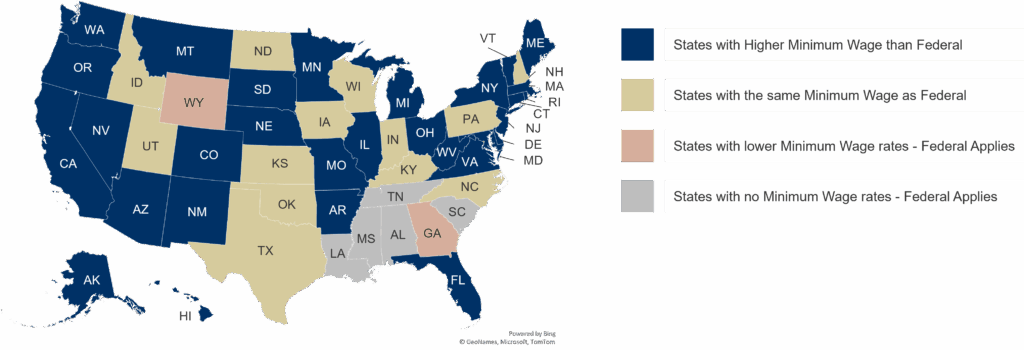
各州の最低賃金
| State/Area | Minimum Wage |
|---|---|
| Alabama (AL) | $7.25 (No state minimum wage law) |
| Alaska (AK) | $13.00 |
| Arizona (AZ) | $14.70 |
| California (CA) | $16.50 |
| Colorado (CO) | $14.81 |
| Connecticut (CT) | $16.35 |
| Delaware (DE) | $15.00 |
| District of Colombia (DC) | $17.95 |
| Florida (FL) | $13.00 *The minimum wage will increase by $1.00 each year until it reaches $15.00 on September 30, 2026. |
| Georgia (GA) | $7.25 (Federal minimum wage applies because the state minimum wage is $5.15.) |
| Guam (GU) | $9.25 |
| Hawaii (HI) | $14.00 |
| Idaho (ID) | $7.25 |
| Illinois (IL) | $15.00 |
| Indiana (IN) | $7.25 |
| Iowa (IA) | $7.25 |
| Kansas (KS) | $7.25 |
| Kentucky (KY) | $7.25 |
| Louisiana (LA) | $7.25 (No state minimum wage law) |
| Maine (ME) | $14.65 |
| Maryland (MD) | $15.00 |
| Massachusetts (MA) | $15.00 |
| Michigan (MI) | $12.48 |
| Minnesota (MN) | $11.13 |
| Mississippi (MS) | $7.25 (No state minimum wage law) |
| Missouri (MO) | $13.75 |
| Montana (MT) | $10.55 |
| Nebraska (NE) | $13.50 |
| Nevada (NV) | $12.00 |
| New Hampshire (NH) | $7.25 |
| New Jersey (NJ) | $15.49 |
| New Mexico (NM) | $12.00 |
| New York (NY) | $15.50 |
| North Carolina (NC) | $7.25 |
| North Dakota (ND) | $7.25 |
| Ohio (OH) | $10.70 |
| Oklahoma (OK) | $7.25 |
| Oregon (OR) | $15.05 |
| Pennsylvania (PA) | $7.25 |
| Rhode Island (RI) | $15.00 |
| South Carolina (SC) | $7.25 (No state minimum wage law) |
| South Dakota (SD) | $11.50 |
| Tennessee (TN) | $7.25 (No state minimum wage law) |
| Texas (TX) | $7.25 |
| Utah (UT) | $7.25 |
| Vermont (VT) | $14.01 |
| Virginia (VA) | $12.41 |
| Washington (WA) | $16.66 |
| West Virginia (WV) | $8.75 |
| Wisconsin (WI) | $7.25 |
| Wyoming (WY) | $7.25 (Federal minimum wage applies because the state minimum wage is $5.15.) |
Minimum Wage in Major Cities
The minimum wage rates for major cities are as follows.3, 4, 5, 6, 7, 8, 9, 10, 11, 12, 13, 14, 15, 16, 17, 18, 19, 20, 21, 22, 23, 24, 25, 26, 27, 28, 29, 30
| State | CIty | Minimum Wage | Effective Date |
|---|---|---|---|
| California (CA) | West Hollywood | $19.65 *Hotel employees $20.22 | July 1, 2025 |
| Mountain View | $19.20 | January 1, 2025 | |
| Emeryville | $19.90 | July 1, 2025 | |
| Sunnyvale | $19.00 | January 1, 2025 | |
| San Francisco | $19.18 | July 1, 2025 | |
| Los Angeles | $17.87 * Employees working in hotels: $22.50) | July 1, 2025 (September 8, 2025) |
|
| San Jose | $17.95 | January 1, 2025 | |
| San Diego | $17.25 | January 1, 2025 | |
| Santa Monica | $17.81 Employees working in hotels: $21.01 | July 1, 2025 | |
| Berkeley | $19.18 | July 1, 2025 | |
| El Cerrito | $18.34 *Specific rates vary by industry. | January 1, 2025 | |
| Palo Alto | $18.20 | January 1, 2025 | |
| Los Altos | $18.20 | January 1, 2025 | |
| Cupertino | $18.20 | January 1, 2025 | |
| Santa Clara | $18.20 | January 1, 2025 | |
| Redwood CIty | $18.20 | January 1, 2025 | |
| Sonoma | $18.02 | January 1, 2025 | |
| Santa Rosa | $17.87 | January 1, 2025 | |
| Colorado (CO) | Denver | $18.81 $19.29 from 2026 | January 1, 2025 |
| Illinois (IL) | Chicago | $16.60 | July 1, 2025 |
| Minnesota (MN) | Minneapolis | $15.97 $16.37 from 2026 | January 1, 2025 |
| Saint Paul | $13.25-15.97 *Varies by employer size. | January 1, 2025 | |
| New York (NY) | New York | $16.50 | January 1, 2025 |
| Long Island, Westchester | $16.50 | January 1, 2025 | |
| Oregon (OR) | Portland Metro | $16.30 | July 1, 2025 |
| Non-urban | $14.05 | July 1, 2025 | |
| Washington (WA) | Seattle | $20.76 | January 1, 2025 |
| Tukwila | $20.10-21.10 *Varies by employer size. | January 1, 2025 | |
| SeaTac | $20.17 | January 1, 2025 | |
| Burien | $20.16 – 21.16 *Varies by employer size. | January 1, 2025 |
Tipped Employee
In the United States, certain industries have a strong tipping culture, including restaurants, hotels, bars, and beauty services. In these industries, a significant portion of employees’ income may depend on tips paid directly by customers. For this reason, the FLSA allows employers to count a portion of employees’ tips toward satisfying the minimum wage requirement, rather than requiring the employer to pay the full minimum wage entirely in cash. This is known as the tip credit system.
Purpose of the System
- Tips paid directly by customers to employees may be included in the minimum wage calculation.
- However, the total of the employee’s tips and the employer’s direct cash wage must not fall below the applicable minimum wage, such as the federal minimum wage of $7.25 per hour.
- If tips are insufficient, the employer is responsible for making up the difference.
In other words, tipped employees may satisfy the minimum wage requirement through a combination of tips and direct wages. However, the fundamental principle is that the employer remains responsible for ensuring that the employee receives at least the applicable minimum wage.
Practical Requirements
Notice Requirement
Employers must notify employees in advance that they intend to apply the tip credit. Although written notice is not strictly required under federal law, the employer bears the burden of proof in the event of litigation or an audit. Therefore, providing written notice is a practical necessity.
Requirement That Employees Retain All Tips
Employees must be allowed to retain all of their tips. Employers may not deduct, divert, or otherwise use employees’ tips for the employer’s own benefit. However, if the employer maintains a valid tip pooling arrangement, tips may be shared among employees who customarily and regularly receive tips.
Restrictions on Tip Pooling Rules
- Only employees who directly provide service to customers may participate, such as servers and bartenders.
- Managers, supervisors, and back-office employees must not be included.
- Under the FLSA, these rules apply to employees who receive more than $30 per month in tips.
Differences Under State Law
Under federal law, the minimum direct cash wage for tipped employees is $2.13 per hour, with a maximum tip credit of $5.12. However, some states impose higher minimum cash wage requirements, while others prohibit the tip credit system entirely, including California, Nevada, Oregon, and Washington.
For companies operating in the United States in the restaurant, hospitality, or service industries, it is essential to confirm the applicable rules in each state where employees work.31
Youth Minimum Wage
Purpose of the System
The youth minimum wage was introduced to expand initial employment opportunities for young workers.32
High school students, college students, and others entering the labor market for the first time often have limited work experience and may initially have lower productivity. As a result, employers may perceive hiring them as a higher-risk decision. The youth minimum wage is intended to make it easier for employers to hire young workers by allowing them to pay a lower wage than the regular minimum wage for the first 90 days of employment.
However, because this system creates a wage difference based on whether a worker is under or over the age of 20, even when performing the same work, it has increasingly been criticized in recent years as a form of age-based discrimination. In practice, the number of employers using this system has declined over time, and it has become largely obsolete.
Overview of the System
- Covered workers: Newly hired employees under the age of 20
- Hourly wage: $4.25
- Applicable period: Within the first 90 calendar days after employment begins
Practical Considerations
- The 90-day period is counted based on calendar days, not days actually worked. Therefore, employers must calculate the period from the employee’s start date, regardless of how many days the employee actually works.
- Once 90 days have passed, or once the worker reaches age 20, whichever comes first, the employer must pay the regular applicable minimum wage, such as the federal minimum wage of $7.25 or the applicable state minimum wage.
Subminimum Wage
There are exceptions that allow certain workers to be employed at a wage below the standard minimum wage. This is known as a subminimum wage.33 Covered categories may include learners, students, workers with disabilities, and students working as part of a school program.
These systems were originally created to expand employment opportunities. In practice, however, employers are generally required to obtain a special certificate, and the administrative process can be burdensome. In addition, because these systems have been criticized as potentially leading to exploitation, an increasing number of states are moving toward eliminating them.
As a result, although these provisions still exist under the law, they are rarely used in modern employment practice.
While setting wages in compliance with these provisions is not itself illegal, employers should recognize that these systems are rarely used in practice and should take care to avoid misunderstandings or improper application.
Relationship with RROP
An essential concept in understanding minimum wage compliance is the Regular Rate of Pay (RROP).
The RROP is the base rate used to calculate overtime pay. At the same time, it also serves as a reference point for determining whether the wages actually paid to an employee fall below the applicable minimum wage.
For example:
- If deductions for uniforms or tools reduce an employee’s effective hourly wage below the minimum wage
- If bonuses or incentives are improperly excluded from the RROP, resulting in undercalculated overtime pay
In this way, minimum wage compliance is not limited to the stated hourly wage itself. It is closely connected to overtime calculations through the RROP.
This article only provides a high-level overview. The specific calculation method for RROP and its relationship with overtime premium pay will be explained in detail in a separate article.
Compliance and Common Violation Examples
Minimum wage violations do not occur only when employers intentionally fail to pay employees properly. In many cases, they arise from a lack of understanding of the rules or errors in wage calculations. This risk is particularly high for Japanese companies operating in the United States, where federal, state, and local requirements may overlap.
Common Violation Examples
- Overlooking state or local minimum wage updates
An employer continues paying only the federal minimum wage, resulting in underpayment. - Failure to make up the difference for tipped employees
An employee’s hourly wage, including tips, falls below $7.25, but the employer fails to pay the shortfall. - Misuse of the youth minimum wage
An employer continues paying $4.25 per hour even after the 90-day period has expired. - Minimum wage violations caused by deductions
An employer requires employees to bear the cost of uniforms or tools, causing their effective hourly wage to fall below the minimum wage. - Errors in RROP calculations
An employer fails to include bonuses or incentives in the Regular Rate of Pay, resulting in underpaid overtime.
Consequences of Violations
- Retroactive payment of unpaid wages
- Additional penalties and civil monetary penalties
- Risk of class-action litigation
- Damage to the company’s brand and reputation
A minimum wage violation that begins as a payroll calculation error affecting only a portion of employees can develop into a company-wide legal and financial risk. HR leaders and executives must continuously monitor legal updates and establish a reliable process for reviewing payroll calculations.
Conclusion
This article introduced the basic framework of the U.S. minimum wage system.
- The U.S. minimum wage system consists of federal, state, and local layers, and employers must always apply the highest applicable rate.
- Some exceptions exist for tipped employees, young workers, and certain other categories, but the requirements for applying these exceptions are strict.
- The subminimum wage still exists under the law, but it is rarely used in modern employment practice.
- Without understanding the relationship between minimum wage and the Regular Rate of Pay, employers may face compliance violations even if they appear to be paying the minimum wage.
- Violations can lead to retroactive payment of unpaid wages, penalties, litigation risk, and reputational damage.
Employers should accurately understand the statutory minimum requirements and continuously monitor updates at the state and local levels.
Related Services
For companies that want to systematically assess U.S. HR compliance risks related to minimum wage requirements, state and local wage rules, overtime, employee classification, timekeeping, leave, and recordkeeping, Cornerstone Strategy LLC offers an HR Compliance Audit.
参考文献
- Minimum Wage | U.S. Department of Labor ↩︎
- State Minimum Wage Laws | U.S. Department of Labor ↩︎
- Minimum Wage | City of West Hollywood ↩︎
- Mountain View Minimum Wage Ordinance | Mountain View, CA – EconDev ↩︎
- Minimum Wage Ordinance – City of Emeryville, CA ↩︎
- Minimum Wage in Sunnyvale | Sunnyvale, CA ↩︎
- Minimum Wage Ordinance | SF.gov ↩︎
- Office of Wage Standards | Wages LA ↩︎
- Minimum Wage Ordinance | City of San José ↩︎
- Earned Sick Leave and Minimum Wage Ordinance | City of San Diego Official Website ↩︎
- santamonica.gov – Minimum Wage ↩︎
- Workforce Standards and Enforcement | City of Berkeley ↩︎
- The El Cerrito minimum wage is different than the California minimum wage. | El Cerrito, CA – Official Website ↩︎
- Minimum Wage – City of Palo Alto, CA ↩︎
- Minimum Wage | Los Altos, CA ↩︎
- Cupertino Minimum Wage Cupertino CA ↩︎
- Minimum Wage Ordinance | City of Santa Clara ↩︎
- Minimum Wage and Wage Theft | City of Redwood City ↩︎
- Sonoma Minimum Wage – City of Sonoma ↩︎
- Minimum Wage | Santa Rosa, CA ↩︎
- Denver’s Minimum Wage in 2025: $18.81/hour – City and County of Denver ↩︎
- City of Chicago :: Minimum Wage ↩︎
- min wage ↩︎
- Minimum Wage | Saint Paul Minnesota ↩︎
- Minimum Wage | Department of Labor ↩︎
- ↩︎
- Minimum Wage – LaborStandards | seattle.gov ↩︎
- 2024-Tukwila-Minimum-Wage-Notice.pdf ↩︎
- City of Seatac Announces 2024 Minimum Wage Adjustments ↩︎
- Minimum Wage – City of Burien ↩︎
- Minimum Wages for Tipped Employees | U.S. Department of Labor ↩︎
- Fact Sheet #32: Youth Minimum Wage – Fair Labor Standards Act | U.S. Department of Labor ↩︎
- 29 USC Ch. 8: FAIR LABOR STANDARDS ↩︎

Disclaimer
This article has been prepared by Cornerstone Strategy LLC for informational purposes only. It is based on generally available information, including publicly available guidelines, regulations, and case law related to U.S. human resources, employment, tax practices, organizational and talent development, leadership development, career development, and coaching. It is provided from the perspective of an HR consultant and coach.
Cornerstone Strategy LLC is not a law firm, accounting firm, licensed tax advisory firm, medical provider, psychotherapy provider, counseling provider, or any other licensed professional practice providing legal, tax, medical, psychological, or therapeutic services.
The content of this article does not constitute legal, accounting, tax, medical, psychological, therapeutic, investment, or other professional advice, and should not be relied upon as such. It does not guarantee legal validity, tax treatment, organizational outcomes, HR outcomes, behavioral change, career outcomes, coaching outcomes, or applicability to any specific situation.
Before making decisions related to employment, tax, contracts, compensation, termination, disciplinary action, HR policies, required forms, or any matter involving physical or mental health, you should consult with qualified professionals such as licensed attorneys, certified public accountants (CPAs), tax advisors, medical professionals, psychologists, or other appropriately licensed professionals who are knowledgeable about applicable federal and state laws and professional standards.
Cornerstone Strategy LLC assumes no responsibility or liability for any loss or damages arising from the use of, reliance on, or actions taken based on this article.