

In U.S. payroll practice, accurately understanding the concept of a workweek has a significant impact on the accuracy of overtime calculations, timekeeping, payroll cutoff procedures, recordkeeping, and audit readiness.
Because the word itself is not difficult, it is easy to assume that a workweek simply means a calendar week. For those who think in terms of a typical office schedule, it may also be tempting to interpret it as Monday through Friday. However, under the U.S. Fair Labor Standards Act (FLSA), a workweek is not merely a calendar week. It is a fixed period of 168 consecutive hours — seven consecutive 24-hour periods — established for purposes such as determining overtime eligibility.1, 2
This article provides a structured overview of the definition of a workweek, how it differs from a pay period, its relationship to overtime calculations, key considerations when changing a workweek, special rules, and common practical pitfalls employers should be aware of.
Table of Contents
Basic Definition of a Workweek
Under the FLSA, a workweek is a fixed and regularly recurring period of seven consecutive 24-hour days, for a total of 168 hours.2 The employer may choose any day and time as the starting point. It does not have to run from 12:00 a.m. Sunday through 11:59 p.m. Saturday. For example, a workweek may begin at 12:00 a.m. on Monday, or it may begin at 8:00 a.m. on Wednesday. Employers are also not required to use the same workweek for all employees. Different workweeks may be established for different employees or groups of employees.2
The key point is that a workweek is not the same as an employee’s actual work schedule. Rather, it is the legal unit used for time aggregation and overtime determination. Even if an employee’s schedule changes from week to week, the starting point of the established workweek generally remains fixed. In other words, a changing schedule does not automatically change the weekly boundary used to determine overtime.1
Workweek
24時間を1日とする7日間(合計168時間)からなる毎週決まって繰り返される一定の期間
Why Is the Workweek Important?
Overtime is determined based on the workweek, not the pay period.
Under the FLSA, non-exempt employees must be paid overtime at a rate of at least 1.5 times their regular rate of pay for all hours worked over 40 in a single workweek.1, 3 The critical point is that overtime must be calculated on a workweek-by-workweek basis, not based on the pay period as a whole. Even if employees are paid on a biweekly or semimonthly payroll cycle, overtime must be evaluated separately for each workweek within that pay period.4
For example, suppose an employee is paid on a biweekly payroll cycle and works 30 hours in Week 1 and 50 hours in Week 2. Although the employee’s average weekly hours over the two-week period are 40 hours, the FLSA does not allow employers to average hours across multiple workweeks. As a result, the employer must pay overtime for the 10 hours worked over 40 in Week 2.4
Difference Between a Workweek and a Pay Period
One of the most commonly confused concepts in payroll practice is the difference between a workweek and a pay period.
Workweek: The legal unit used to determine overtime
Pay period: The administrative period used to calculate and pay wages
For example, even if a company uses a biweekly pay period, those two weeks must be broken down into two separate workweeks, and each workweek must be reviewed individually to determine whether the employee worked more than 40 hours.
Regardless of whether wages are paid weekly, biweekly, semimonthly, or monthly, the FLSA standard for overtime determination is the workweek.
If a payroll system is designed without clearly distinguishing these two concepts, errors are especially likely to occur in semimonthly payroll. A semimonthly pay period typically runs from the 1st to the 15th of the month, and from the 16th to the end of the month. However, those periods often do not align with the established workweek.
For example, assume the employer uses a workweek that runs from 12:00 a.m. Monday through 11:59 p.m. Sunday, and pays employees on a semimonthly basis. For the week of March 30, 2026
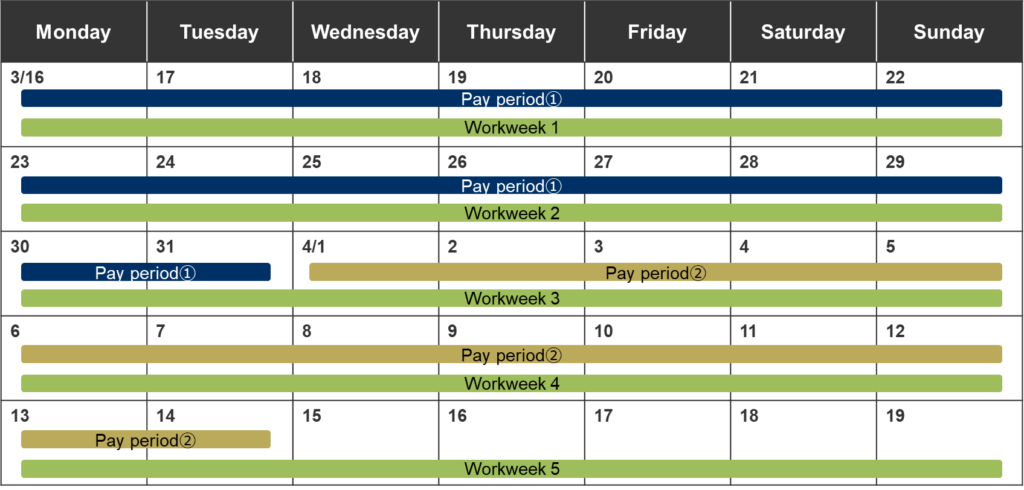
Workweek: 12:00 a.m. Monday, March 30, 2026 to 11:59 p.m. Sunday, April 5, 2026
In this type of situation, where the pay period and workweek do not align, the payroll system must have a separate overtime calculation logic based on the workweek. This is a highly important practical issue in payroll administration.
Each Workweek Stands Alone
Under the FLSA, the principle is that each workweek stands alone. 4 This means that an employer cannot offset hours not worked in one week against excess hours worked in another week. Even in workplaces where business volume fluctuates due to operational needs, employers may not handle overtime by saying, “The employee worked 50 hours this week and 30 hours last week, so the average is 40 hours per week.”
In addition, if an employee performs multiple jobs for the same employer, all hours worked for that employer during the applicable workweek must generally be combined for overtime purposes. The fact that the employee works in different departments or performs different types of duties does not create separate 40-hour thresholds for each role.
Relationship to Holiday Work, Weekend Work, and Work on Scheduled Days Off
If employers apply a Japanese payroll mindset directly to U.S. practice, they may assume that working on a day off automatically triggers premium pay. However, that is not how the FLSA works. Under federal law, premium pay is not automatically required simply because an employee works on a Saturday, Sunday, holiday, or scheduled day off.5 The key question is whether the employee’s total hours worked in that workweek exceeded 40 hours.
Therefore, even if an employee works eight hours on a Saturday, the time is not considered overtime under federal law if the employee’s total hours for that workweek are 40 or fewer. Conversely, if an employee works a total of 45 hours only on weekdays, the final five hours are considered overtime. Again, overtime determination is based not on the day of the week, but on the total number of hours worked within the workweek.
Relationship Between the Workweek and “Hours Worked”

The importance of the workweek is not limited to defining the weekly framework. In practice, payroll accuracy depends heavily on determining which hours must be counted as hours worked within that workweek.
According to the DOL, time an employee spends on the employer’s premises, on duty, or at a prescribed workplace is generally counted as part of the workweek. A workday refers to the period between the time an employee begins and ends their principal activities, and therefore is not necessarily limited to the employee’s scheduled shift hours.6
In addition, even if the employer did not expressly instruct the employee to perform the work, the time must be counted as hours worked if the employer knew or had reason to know that the employee was working. For example, if an employee voluntarily stays after the scheduled end of the workday to finish assigned tasks or correct mistakes, that time is generally considered compensable hours worked.
Waiting time also cannot automatically be treated as unpaid time. The DOL explains that when an employee is required to wait in a way that primarily benefits the employer, or is “engaged to wait,” that time is considered hours worked. For example, a secretary waiting for instructions or a firefighter waiting while on duty is not using the time freely for personal purposes. Rather, the employee is waiting as part of the job, and that time is included as hours worked.
On-Call Time
On-call time refers to time during which an employee is required to remain on the employer’s premises.6
As a general rule, on-call time spent on the employer’s premises is considered hours worked. By contrast, on-call time spent at home, or time during which the employee is merely required to remain reachable, is often not counted as hours worked. However, if significant additional restrictions are placed on the employee’s freedom to use the time for personal purposes, the time may be considered compensable.
Rest Breaks and Meal Periods
Short rest breaks, typically lasting 20 minutes or less, must be counted as hours worked because they are generally considered to promote employee efficiency.6
By contrast, meal periods, generally lasting 30 minutes or more, do not need to be counted as hours worked if the employee is completely relieved from duty for the purpose of eating a meal.
However, if the employee is required to answer phone calls during lunch, respond to visitors, remain at their desk, or otherwise continue to perform or be available for work, the employee is not considered completely relieved from duty. In that case, the meal period must be counted as hours worked.
Sleeping Time
When an employee is required to be on duty for less than 24 hours, the time is generally considered hours worked, even if the employee is allowed to sleep or engage in personal activities during periods when they are not actively performing tasks.6
By contrast, for duty periods of 24 hours or more, the employer and employee may agree to exclude a bona fide sleeping period of up to eight hours from hours worked, provided certain conditions are met. These include having adequate sleeping facilities and the employee usually being able to sleep without interruption. However, if the employee does not receive at least five hours of sleep, the sleeping time exclusion is not permitted.
Training, Seminars, and Similar Activities
Training programs, seminars, lectures, and similar activities may generally count as hours worked.
The DOL provides that time spent attending these activities does not need to be counted as hours worked only if all four of the following conditions are met:6
- The attendance occurs outside the employee’s regular working hours,
- Attendance is voluntary,
- The program is not directly related to the employee’s job, and
- The employee does not perform any productive work while attending
Therefore, if any one of these conditions is not met, the time typically must be treated as hours worked.
Travel Time and Business Travel
Ordinary commuting from home to the regular workplace and back, often referred to as home-to-work travel, is generally not considered hours worked.6
However, when an employee is given a special one-day assignment in another city, the travel time to and from that city generally counts as hours worked, except that the employer may exclude the time the employee would normally spend commuting. In addition, time spent traveling between different job sites during the same workday is considered part of the employee’s principal work activities and must be counted as hours worked.
For overnight travel, travel time that overlaps with the employee’s normal working hours must be treated as hours worked, even if the travel occurs on a nonworking day. By contrast, the DOL provides that time spent outside normal working hours merely as a passenger on an airplane, train, boat, bus, or automobile is not considered hours worked.
As these examples show, the hours worked that must be counted within a workweek cannot be determined simply by looking at clock-in and clock-out times. Unapproved overtime, waiting time, on-call time, short rest breaks, work performed during lunch, training attendance, and travel time must all be addressed correctly for workweek-based overtime calculations to function properly.
For this reason, payroll practice requires not only a clear definition of when the workweek begins, but also a clear policy on what counts as hours worked. Employers should document these rules in their timekeeping policy and reinforce them through manager training.
Can an Employer Change the Workweek?
In short, yes. The starting point of a workweek can be changed.
However, certain conditions apply.
Under the DOL’s interpretation, the change must be intended to be permanent, not temporary, and it must not be made for the purpose of avoiding overtime requirements.2, 7
For example, it would be risky to shift the start of the workweek only because the employer expects significant overtime in a particular week. A workweek change should be based on a legitimate business reason, such as an operational restructuring, a permanent revision to the shift system, or payroll system standardization. The reason for the change should also be documented.
How to Calculate Hours Worked and Overtime When Changing the Workweek
To ensure that employees receive all overtime premiums they are entitled to when a workweek is changed, employers should follow a careful calculation process.
A basic approach is as follows:
- Calculate the overtime hours and overtime pay by assigning the overlapping day to the old workweek.
- Calculate the overtime hours and overtime pay by assigning the same overlapping day to the new workweek.
- Compare the two results and use the method that is more favorable to the employee, meaning the method that results in the higher payment.
Example
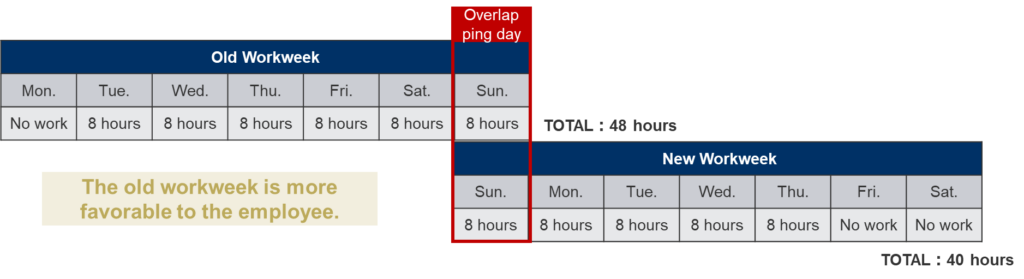
Assume a company changes its workweek from a Monday-through-Sunday schedule to a Sunday-through-Saturday schedule.
During the transition, a nonexempt employee works the following hours over the relevant two-week period.
Old Workweek
- Monday: No work
- Tuesday: 8 hours
- Wednesday: 8 hours
- Thursday: 8 hours
- Friday: 8 hours
- Saturday: 8 hours
- Sunday: 8 hours
New Workweek
- Sunday: 8 hours
- Monday: 8 hours
- Tuesday: 8 hours
- Wednesday: 8 hours
- Thursday: 8 hours
- Friday: No work
- Saturday: No work
How to Calculate Overtime Hours
The employee’s overtime hours would be calculated as follows.
- Assign the overlapping Sunday to the old workweek
Under the old workweek, the employee worked 40 hours from Monday through Saturday. Adding the 8 hours worked on Sunday results in a total of 48 hours. - Assign the overlapping Sunday to the new workweek
Under the new workweek, the employee worked 8 hours on Sunday and 32 hours from Monday through Thursday, for a total of 40 hours. - Use the calculation that results in the greater number of compensable overtime hours
In this example, the 48-hour calculation is greater. Therefore, overtime pay should be calculated based on that result.
Practical Considerations
When an employer changes the workweek, the transition between the old workweek and the new workweek may cause the same day to overlap between the two weekly periods. In these situations, simply applying the new workweek boundary may result in the employee receiving less overtime premium than they are entitled to.
For that reason, employers should calculate the result both ways: once by assigning the overlapping day to the old workweek, and once by assigning it to the new workweek. The employer should then apply the calculation that is more favorable to the employee.
When Should Overtime Premiums Be Paid?
The FLSA does not require overtime premiums to be paid on a particular payroll cycle. Paying employees on a biweekly or semimonthly basis is generally permissible. The important point is that overtime premiums earned in a particular workweek should be paid on the regular payday for the pay period that includes that workweek. If the exact amount cannot be determined immediately due to payroll calculation issues, the employer is expected to pay it as soon as practicable.
This point is very important in practice.
For example, if commissions, allowances, incentives, or other forms of compensation are not finalized in time for payroll processing, the employer should have a predefined process for recalculating the employee’s regular rate of pay (RROP) and paying any additional overtime premium owed.
In this way, handling situations where the workweek boundary and the payroll cutoff date do not align is not merely an accounting or administrative issue. It is also an important wage and hour compliance matter.
Special Rules
Fluctuating Workweek Method
In general, overtime premiums are calculated based on at least 1.5 times the employee’s regular rate of pay (RROP).
However, employees do not always work the same number of hours every week. In fact, fluctuating hours may be quite common. An employee may work 30 hours one week, 45 hours the next week, and 50 hours in another week. When an employee is paid a fixed weekly salary under this type of fluctuating schedule, the employer may, in some cases, be able to use a special calculation method known as the Fluctuating Workweek Method.8
Under the standard overtime calculation, overtime hours are generally paid at 1.5 times the regular rate. Under the Fluctuating Workweek Method, however, the employer first divides the fixed weekly salary by the total number of hours worked in that week to determine the RROP. The employer then pays an additional 0.5 times the RROP for the hours worked over 40.
This method is available only when certain conditions are met, such as when the employee’s hours actually fluctuate from week to week and the employee receives a fixed weekly salary regardless of the number of hours worked.
The “8/80 Rule” Used by Hospitals and Care Facilities
In certain workplaces, such as hospitals and care facilities, a special overtime system known as the 8/80 rule may be available instead of the standard rule requiring overtime after 40 hours in one workweek.
Under the 8/80 rule, overtime is determined over a fixed 14-day period.9
Specifically, overtime premiums must be paid for:
- Hours worked over 8 in a single day
- Hours worked over 80 in the 14-day period
Unlike the standard rule, this system does not rely solely on the “over 40 hours in one workweek” threshold. Instead, it requires employers to check overtime on both a daily basis and a 14-day basis.
However, this system is not available to all employers. It is generally limited to certain employers in the healthcare and care facility sectors, and it requires a prior agreement before implementation.
Therefore, in payroll practice for healthcare and care facility employers, it is important to first confirm whether the workplace is using the standard workweek rule or the 8/80 rule.
There are also other special rules for certain public service roles, such as firefighters and police officers. Although this article does not cover those rules in detail, they exist because public sector roles may involve work arrangements that differ significantly from those of private-sector employees.
Workweek from a Recordkeeping Perspective
The FLSA requires employers to maintain accurate records of hours worked and wages owed for each nonexempt employee. Although the FLSA does not require a specific format, if the employer’s workweek is not clearly defined, records may become inconsistent. This can create disadvantages in audits, wage claims, or internal reviews.
In practice, employers should document at least the following:
- The starting day and time of the workweek for each employee group
- The relationship between the workweek and the pay period
- Approval rules for time clock corrections
- Reporting rules for unreported working time
- Approval procedures and transition calculation methods when changing the workweek
Ideally, these rules should be reflected consistently in the Employee Handbook, Payroll Standard Operating Procedure (Payroll SOP), timekeeping policy, and manager training.
This is a practical way to translate the employer’s recordkeeping obligations and overtime calculation obligations into payroll operations.
Common Misunderstandings in Practice
Misunderstanding 1: Overtime Is Paid for Weekend Work
Under federal law, work performed on Saturdays, Sundays, or holidays does not automatically require premium pay.
Misunderstanding 2: No Overtime Is Owed If the Employee Works 80 Hours or Less in a Biweekly Pay Period
As discussed above, the workweek and the pay period are separate concepts. Employers may not use a weekly average across a biweekly pay period to avoid overtime.
Misunderstanding 3: The Pay Period and Workweek Are the Same Thing
As noted earlier, the pay period is the payroll payment cycle, while the workweek is the unit used to determine overtime.
Misunderstanding 4: The Workweek Can Be Shifted Only for a Busy Week
An employer should not temporarily move the start of the workweek simply because a particular week is expected to generate significant overtime. A workweek change should be intended to be permanent and should not be made to avoid overtime obligations.
Misunderstanding 5: The Workweek Does Not Matter for Salaried Employees
Even for nonexempt salaried employees, the workweek is necessary for determining overtime. The same is true when using the Fluctuating Workweek Method.
Relationship to State Law and Local Regulations
The discussion above primarily addresses the minimum standards under federal law. In practice, the laws of the state where the workplace is located may impose stricter requirements.
Therefore, in payroll practice, it is important to first understand the federal workweek concept and then review applicable state laws and local regulations, including county and city requirements.
Implications for Employers
From a payroll operations perspective, employers should not treat the workweek as merely a system configuration item. It should be designed as a foundational rule for overtime management.
Specifically, employers should determine which workweek applies to each employee group, confirm that the timekeeping system and payroll system use consistent workweek boundaries, train managers to prevent off-the-clock work, and then layer on any additional requirements under state law.
Doing so can improve not only legal compliance, but also the ease of explaining payroll rules to employees, audit readiness, and consistency when policies or systems are changed.
Conclusion
In U.S. payroll practice, a workweek is a legal unit consisting of a fixed and regularly recurring period of seven consecutive 24-hour days, for a total of 168 hours. It is the starting point for overtime determination.
Unlike a pay period, the workweek stands alone. Employers may not average hours across multiple weeks, and each workweek must be treated independently. Under federal law, the key question is not whether the employee worked on a holiday or scheduled day off, but whether the employee worked more than 40 hours within the workweek. Employers should also clearly document how waiting time, rest breaks, meal periods, and similar time should be handled, ideally in the Employee Handbook or related payroll and timekeeping policies.
A workweek can be changed, but the change should be based on a reasonable business justification, intended to be permanent, and not made for the purpose of avoiding overtime obligations. Employers should also carefully handle the calculation process during the transition week when changing the workweek.
In addition, state laws, county and city regulations, and special rules for certain workplaces or job categories may apply. Employers should be especially careful when opening a new workplace or expanding into a new jurisdiction.
Payroll accuracy is not determined only by tax rates and deduction settings. The quality of U.S. payroll operations depends on a deeper design question: which hours are counted, in which week, and under which legal unit.
The workweek is at the center of that framework.
Related Services
For companies that want to systematically assess U.S. HR compliance risks, Cornerstone Strategy LLC offers an HR Compliance Audit covering HR documents, employee classification, wage and overtime practices, timekeeping, leave, and recordkeeping.
参考文献
- Fact Sheet #23: Overtime Pay Requirements of the FLSA | U.S. Department of Labor ↩︎
- §778.105 Determining the workweek | eCFR ↩︎
- Wages and the Fair Labor Standards Act | U.S. Department of Labor ↩︎
- §778.104 Each workweek stands alone | eCFR ↩︎
- Overtime Pay | U.S. Department of Labor ↩︎
- Fact Sheet #22: Hours Worked Under the Fair Labor Standards Act (FLSA) | U.S. Department of Labor ↩︎
- §778.301 Overlapping when change of workweek is made | eCFR ↩︎
- Fact Sheet #82: Fluctuating Workweek Method of Computing Overtime Under the Fair Labor Standards Act (FLSA) / “Bonus Rule” Final Rule | U.S. Department of Labor ↩︎
- Fact Sheet #54: The Health Care Industry and Calculating Overtime Pay | U.S. Department of Labor ↩︎

Disclaimer
This article has been prepared by Cornerstone Strategy LLC for informational purposes only. It is based on generally available information, including publicly available guidelines, regulations, and case law related to U.S. human resources, employment, tax practices, organizational and talent development, leadership development, career development, and coaching. It is provided from the perspective of an HR consultant and coach.
Cornerstone Strategy LLC is not a law firm, accounting firm, licensed tax advisory firm, medical provider, psychotherapy provider, counseling provider, or any other licensed professional practice providing legal, tax, medical, psychological, or therapeutic services.
The content of this article does not constitute legal, accounting, tax, medical, psychological, therapeutic, investment, or other professional advice, and should not be relied upon as such. It does not guarantee legal validity, tax treatment, organizational outcomes, HR outcomes, behavioral change, career outcomes, coaching outcomes, or applicability to any specific situation.
Before making decisions related to employment, tax, contracts, compensation, termination, disciplinary action, HR policies, required forms, or any matter involving physical or mental health, you should consult with qualified professionals such as licensed attorneys, certified public accountants (CPAs), tax advisors, medical professionals, psychologists, or other appropriately licensed professionals who are knowledgeable about applicable federal and state laws and professional standards.
Cornerstone Strategy LLC assumes no responsibility or liability for any loss or damages arising from the use of, reliance on, or actions taken based on this article.